Spontaneous emission is a process in which a quantum mechanical system spontaneously transitions from a high-energy state to a low-energy state. It is accompanied by emission of light, through which the energy difference is released.
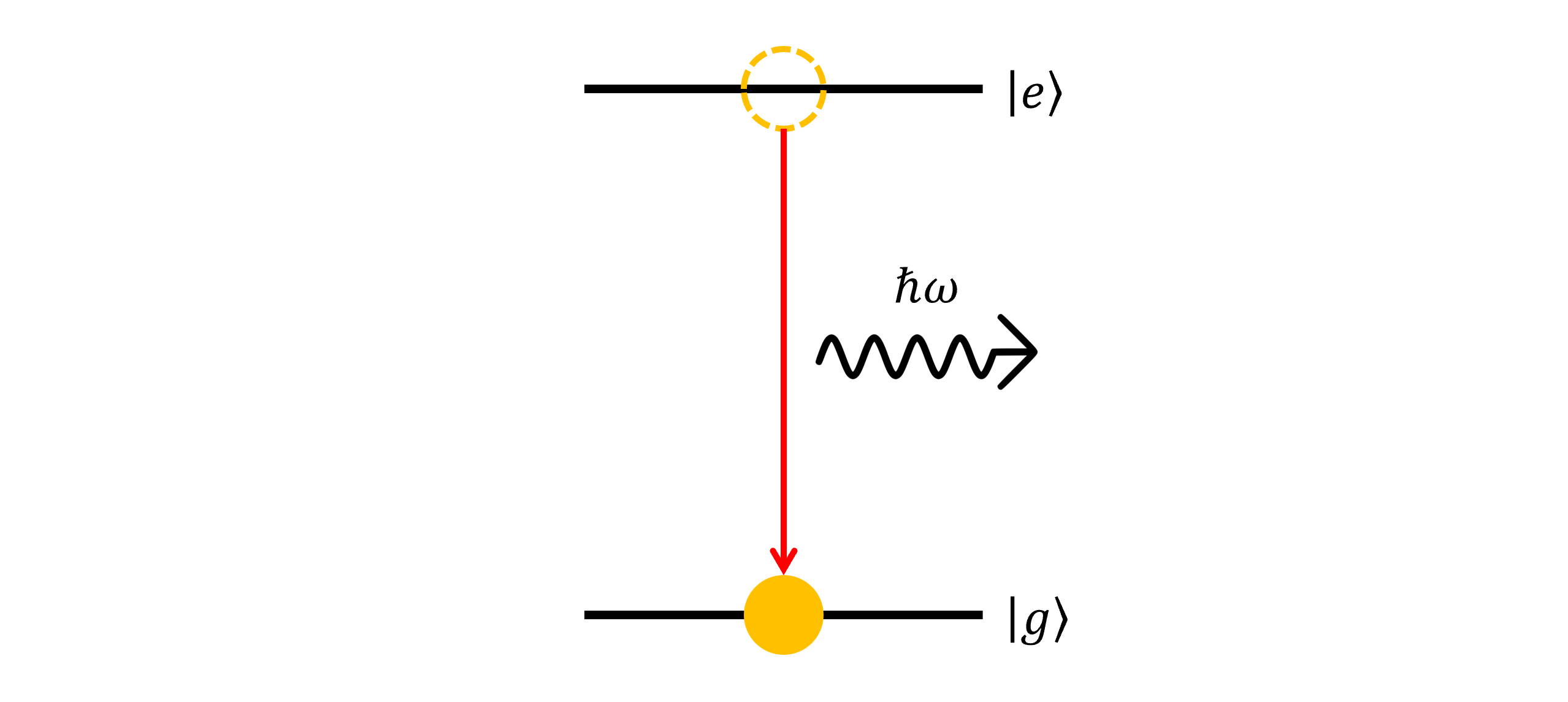
Figure 1 A schematic illustration of spontaneous emission.
Let's think of a typical quantum mechanical system - a single atom. The atom is modeled as a two level system - consisting of a ground state, $\ket{g}$, and an excited state, $\ket{e}$, which are the two (approximately complete) eigenstates of the single atom's Hamiltonian $\hat{\mathcal{H}} _ 0$. Quantum mechanics predicts that each energy eigenstate remains stationary except for a phase change throughout time evolution. This means if the atom is initially in the $\ket{e}$ state, it will never drop to the $\ket{g}$ state.
However, the $\ket{e} \rightarrow \ket{g}$ transition could occur if the system's Hamiltonian is perturbed by an interaction. The states $\ket{g}$ and $\ket{e}$ are no longer the eigenstates of the new perturbed Hamiltonian, $\hat{\mathcal{H}} = \hat{\mathcal{H}} _ 0 + \hat{\mathcal{H}} _ {int}$, so although the atom started as the $\ket{e}$ state, the $\ket{g}$ state component could arise as time evolves, causing spontaneous emission.
The Semi-Classical Approach to Spontaneous Emission
The semi-classical approach to spontaneous emission explains this perturbation through the interaction of the atom with an external electric field $\mathbf{E} = \mathbf{E} _ 0 \cos(\omega t)$. Denoting the dipole moment operator of the atom as $\hat{\mathbf{d}}$, the interaction Hamiltonian is derived as: $$\hat{\mathcal{H}} _ {int} = - \hat{\mathbf{d}} \cdot \mathbf{E}$$ The quantity directly related to the transition rate from $\ket{e}$ to $\ket{g}$ is the matrix element of the interaction Hamiltonian: $$\bra{e}\hat{\mathcal{H}} _ {int}\ket{g}=-\bra{e}\hat{\mathbf{d}} \cdot \mathbf{E}\ket{g}=-\bra{e}\hat{\mathbf{d}} \ket{g} \cdot \mathbf{E}$$ This elucidates the proportionality of the transition rate and to the transition dipole moment, $\mathbf{d} _ {eg} := \bra{e} \hat{\mathbf{d}} \ket{g}$, which is indeed observed in reality.
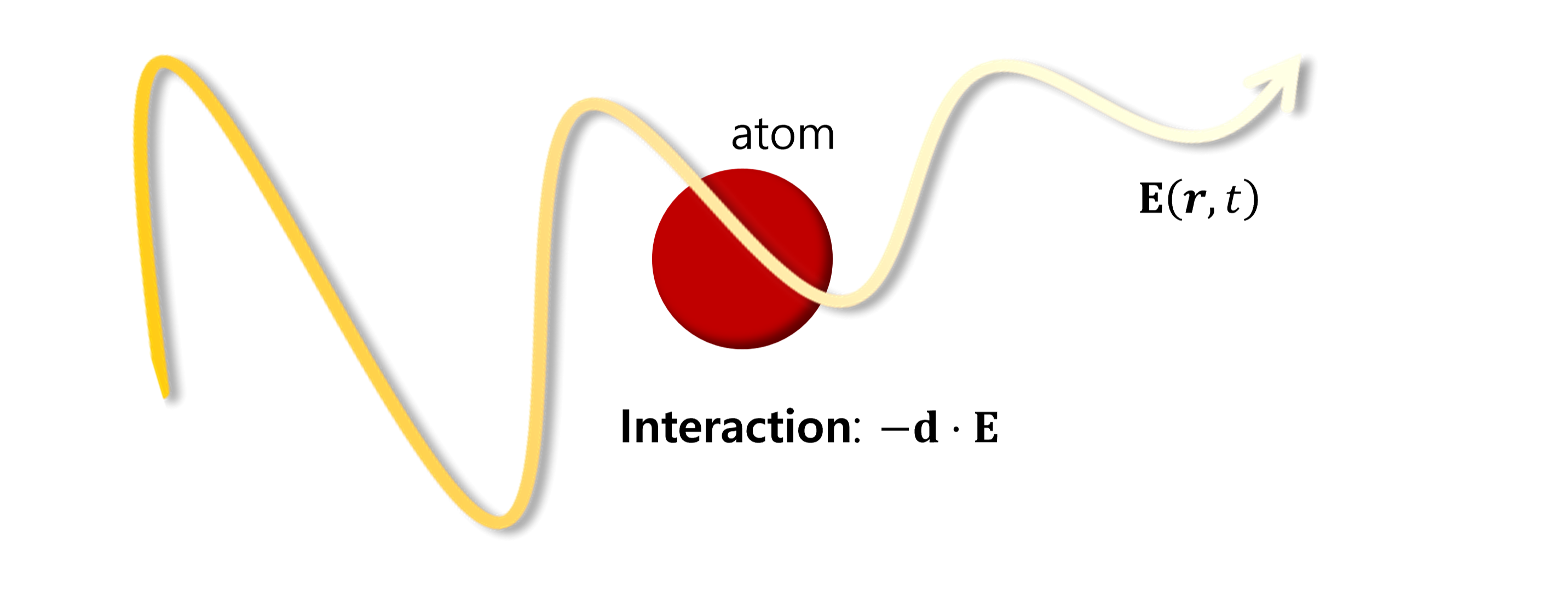
Figure 2 Interaction between the atom and the electric field imposes a perturbation to the Hamiltonian.
However, the semi-classical approach possesses a critical flaw: the interaction Hamiltonian requires a nonzero external electric field $\mathbf{E}$. Yet spontaneous emission occurs even in a vacuum with no external electric field applied!
This contradiction is resolved by introducing one more quantum mechanical concept: the quantization of electromagnetic fields. The vacuum fluctuation of the quantized electromagnetic fields interact with the atom.
Spontaneous Emission in Quantum Electrodynamics
Long story short, the quantum theory of electromagnetic fields states that the electric and magnetic fields should be described by electric and magnetic field operators, expressed as: $$\hat{\mathbf{E}}(\mathbf{r}) = \sum _ {\mathbf{k}, \alpha} {\mathbf{e} _ {\mathbf{k},\alpha} \mathcal{E} _ {\mathbf{k}}\hat{a} _ {\mathbf{k},\alpha}\exp\left(i\mathbf{k}\cdot\mathbf{r}\right)} + \mathrm{H.C.}$$ $$\hat{\mathbf{B}}(\mathbf{r}) = \sum _ {\mathbf{k}, \alpha} \left( \frac{\mathbf{k} \times \mathbf{e} _ {\mathbf{k},\alpha}}{\omega _ {\mathbf{k}}} \right) \mathcal{E} _ {\mathbf{k}} \hat{a} _ {\mathbf{k},\alpha}\exp\left(i\mathbf{k}\cdot\mathbf{r}\right) + \mathrm{H.C.}$$ Here, $\mathbf{k}$ and $\alpha$ represent the wave vector and the polarization of each plane wave mode, so the $\sum _ {\mathbf{k},\alpha}$ is the summation over all the available planar wave modes. $\mathcal{E} _ {\mathbf{k}}$ is a constant defined as $\mathcal{E} _ {\mathbf{k}}=\sqrt{\frac{\hbar \omega _ {\mathbf{k}}}{2\epsilon _ 0 V}}$. $\mathbf{e} _ {\mathbf{k},\alpha}$ and $\omega _ {\mathbf{k}}$ are the unit vector in the direction of the electric field, and the angular frequency, respectively, corresponding to each mode. $\hat{a} _ {\mathbf{k}, \alpha}$ is the annihilation operator for the corresponding mode, of which the effect is to annhilate a single photon (with energy $\hbar \omega _ {\mathbf{k}}$) from the mode. The Hamiltonian for the $\mathbf{k}$, $\alpha$ mode of the electromagnetic field is expressed as: $$\hat{\mathcal{H}} _ {\mathbf{k},\alpha} = \hbar \omega _ {\mathbf{k}} \hat{a}^\dagger _ {\mathbf{k}, \alpha} \hat{a} _ {\mathbf{k}, \alpha}$$ where $\hat{a}^\dagger _ {\mathbf{k}, \alpha}$, the Hermitian adjoint of the annihilation operator $\hat{a} _ {\mathbf{k}, \alpha}$, is the creation operator which creates a single photon for the corresponding mode. The product $\hat{a}^\dagger _ {\mathbf{k}, \alpha} \hat{a} _ {\mathbf{k}, \alpha}$ acts as the number operator: its eigenvalues are the number of photons in the mode. Thus the eigenstates of the Hamiltonian $\hat{\mathcal{H}} _ {\mathbf{k},\alpha}$, denoted as $\ket{n _ {\mathbf{k},\alpha}}$, are interpreted as possessing $n\in \mathbb{N} _ 0$ photons.
The free Hamiltonian without any interaction between the atom and the electromagnetic field is: $$\hat{\mathcal{H}} _ 0=\hbar \omega _ 0 \ket{e}\bra{e} + \sum _ {\mathbf{k},\alpha}{\hbar \omega _ {\mathbf{k}}\hat{a}^\dagger _ {\mathbf{k}, \alpha} \hat{a} _ {\mathbf{k}, \alpha}}$$ Here, the energy of the ground state $\ket{g}$ is set to zero, while $\ket{e}$ has energy of $\hbar \omega _ 0$. Meanwhile, the interaction Hamiltonian is given as: $$\hat{\mathcal{H}} _ {int} = - \hat{\mathbf{d}} \cdot \hat{\mathbf{E}}$$ According to Fermi's golden rule, for a small perturbation $\hat{\mathcal{H}^{\prime}}$, the transition probability per unit time, from the initial state $\ket{i}$ to the final state $\ket{f}$ is given, to first order approximation, by: $$\Gamma _ {i\rightarrow f} = \frac{2\pi}{\hbar} |\bra{f}\hat{\mathcal{H}^\prime}\ket{i}|^2 \delta(E _ f-E _ i)$$ Let's assume the initial state and the final state of the system as follows:
Initial state: $\ket{e}\otimes\ket{0}$
- The atom is in its excited state, while every modes of the electromagnetic field is in the vacuum state.
Final state: $\ket{g}\otimes\ket{1 _ {\mathbf{k},\alpha}}$
- The atom is in its ground state, while the $\mathbf{k}$, $\alpha$ mode of the electromagnetic field has gained one photon.
Note that the evolution from the initial state to the final state has occurred due to the presence of the interaction $\hat{\mathcal{H}} _ {int}$.

Figure 3 The initial and the final states of the spontaneous emission process. The electromagnetic field state is also considered along with the atom state.
Then, utilizing the Fermi's golden rule, if the interaction is small, we obtain the probability per unit time for this transition as: $$\Gamma _ {\mathbf{k},\alpha}= \frac{2\pi}{\hbar}\left| (\bra{g}\otimes\bra{1 _ {\mathbf{k,\alpha}}}) \hat{\mathcal{H}} _ {int} (\ket{e}\otimes\ket{0}) \right|^2 \delta(E _ g+\hbar\omega _ {\mathbf{k}}-E _ e)$$ where $E _ e$ and $E _ g$ are the energy of the atom's excited state and ground state, respectively. Plugging in the expression for the electric field operator, $\hat{\mathcal{H}} _ {int}$ can be written out as:
$$\hat{\mathcal{H}} _ {int} = - \hat{\mathbf{d}} \cdot \hat{\mathbf{E}} = -\sum _ {\mathbf{k}, \alpha} \left[(\hat{\mathbf{d}}\cdot{\mathbf{e} _ {\mathbf{k},\alpha}) \mathcal{E} _ {\mathbf{k}}\hat{a} _ {\mathbf{k},\alpha}\exp\left(i\mathbf{k}\cdot\mathbf{r}\right)} + (\hat{\mathbf{d}}\cdot{\mathbf{e}^* _ {\mathbf{k},\alpha}) \mathcal{E} _ {\mathbf{k}}\hat{a}^\dagger _ {\mathbf{k},\alpha}\exp\left(-i\mathbf{k}\cdot\mathbf{r}\right)}\right]$$
This leads to:
$$\begin{aligned} (\bra{g}\otimes\bra{1 _ {\mathbf{k,\alpha}}}) \hat{\mathcal{H}} _ {int} (\ket{e}\otimes\ket{0}) &= -(\bra{g}\otimes\bra{1 _ {\mathbf{k,\alpha}}}) (\hat{\mathbf{d}}\cdot{\mathbf{e}^* _ {\mathbf{k},\alpha}) \mathcal{E} _ {\mathbf{k}}\hat{a}^\dagger _ {\mathbf{k},\alpha}\exp\left(-i\mathbf{k}\cdot\mathbf{r}\right)} (\ket{e}\otimes\ket{0}) \\ &= \mathcal{E} _ {\mathbf{k}} \exp(-i\mathbf{k}\cdot\mathbf{r}) \times (\bra{g}\hat{\mathbf{d}}\ket{e}\cdot\mathbf{e} _ {\mathbf{k},\alpha}) \times \bra{1 _ {\mathbf{k},\alpha}}\hat{a}^\dagger _ {\mathbf{k},\alpha}\ket{0} \end{aligned}$$
Here, if we define $\bra{g}\hat{\mathbf{d}}\ket{e} := \mathbf{d} _ {ge}$, $\omega _ 0 := (E _ e - E _ g)/\hbar$, and use the relation $\hat{a}^\dagger _ {\mathbf{k},\alpha}\ket{0} = \ket{1 _ {\mathbf{k},\alpha}}$, we arrive at the following expression for $\Gamma _ {\mathbf{k},\alpha}$:
$$\Gamma _ {\mathbf{k},\alpha} = \frac{1}{\hbar}\frac{\pi \omega _ {\mathbf{k}}}{\epsilon _ 0 V} \left| \mathbf{d} _ {ge} \cdot \mathbf{e}^* _ {\mathbf{k},\alpha} \right|^2 \delta(\omega _ \mathbf{k}-\omega _ 0)$$
The total transition probability per unit time, of which the process undergoes the initially excited atom returning to the ground state, accompanied by any of the electromagnetic field modes acquiring a photon, is then calculated as:
$$\Gamma = \sum _ {\mathbf{k},\alpha}\Gamma _ {\mathbf{k},\alpha}$$ Usually, the wave vector $\mathbf{k}$ of the electromagnetic field modes varies continuously. In that case, the discrete summation over $\mathbf{k}$ is replaced with a continuous integral: $$\sum _ {\mathbf{k}} \longrightarrow V \times \int g(\mathbf{k})d^3 \mathbf{k}$$
Here, $V$ is the physical volume of the system, and $g(\mathbf{k})$ is the density of states at wave vector $\mathbf{k}$. In free space, which can be thought of as an infinitely large cube with periodic boundary conditions, it can easily be shown that $g(\mathbf{k}) = 1/8\pi^3$. Thus, the transition rate is expressed as:
$$\begin{aligned} \Gamma &= \frac{V}{8\pi^3} \int \Gamma _ {\mathbf{k},\alpha} d^3 \mathbf{k} \\ &= \frac{1}{8\pi^2 \epsilon _ 0 \hbar} \int d^3 \mathbf{k} \ k \delta\left(k -\frac{\omega _ 0}{c}\right) \sum _ \alpha | \mathbf{d} _ {ge} \cdot \mathbf{e}^{ * } _ {\mathbf{k},\alpha} |^2 \\ &= \frac{1}{8\pi^2 \epsilon _ 0 \hbar} \int _ 0^{\infty} \int _ 0^{\pi} \int _ 0^{2\pi} k^2 \sin \theta dk d\theta d \phi \ k \delta\left(k -\frac{\omega _ 0}{c}\right) \sum _ \alpha | \mathbf{d} _ {ge} \cdot \mathbf{e}^{ * } _ {\mathbf{k},\alpha} |^2 \end{aligned}$$
Here, the dispersion relation $\omega _ {\mathbf{k}}=ck$ in vacuum is used. $\left| \mathbf{d} _ {ge} \cdot \mathbf{e}^* _ {\mathbf{k},\alpha} \right|^2$ is the square of the projection of $\mathbf{d}_{ge}$, onto the plane perpendicular to $\mathbf{k}$. Thus, the sum over $\alpha$ is determined by:
$$\sum _ \alpha \left| \mathbf{d} _ {ge} \cdot \mathbf{e}^* _ {\mathbf{k},\alpha} \right|^2 = \left| \mathbf{d} _ {ge} \right|^2 - \left| \mathbf{d} _ {ge}\cdot \frac{1}{k}\mathbf{k} \right|^2$$
This gives:
$$\int _ 0^\pi \int _ 0^{2\pi} d\theta d\phi \ \sin \theta \sum _ \alpha \left| \mathbf{d} _ {ge} \cdot \mathbf{e}^* _ {\mathbf{k},\alpha} \right|^2 = \frac{8\pi}{3} |\mathbf{d} _ {ge}|^2$$
Plugging in this equation, we obtain:
$$\Gamma = \frac{|\mathbf{d} _ {ge}|^2}{3\pi \epsilon _ 0 \hbar} \int _ 0^\infty dk \ k^3\delta\left(k-\frac{\omega _ 0}{c}\right) = \frac{\omega _ 0^3 |\mathbf{d} _ {ge}|^2}{3\pi \epsilon _ 0 \hbar c^3}$$
This is the spontaneous emission rate of an excited atom in free space. Note that it increases with the transition dipole moment, as well as the energy difference between the ground and excited states of the atom.