- Fan, X., Xiong, W., Xu, K. et al. Spatial light modulator via optically addressed metasurface. Nat. Nanotechnol. 21, 561–570 (2026).
Introduction
Spatial light modulators (SLMs) have been a crucial element in the development of optical imaging techonology, such as holographic displays and augmented/virtual reality (AR/VR) displays, which require dynamic wavefront modulation. For example, in ideal holographic displays, SLMs are utilized to produce the appropriate complex amplitude of light, which propagates through space and forms the desired 3D image for a single time step. In such applications, the spatiotemporal product density (STPD) - defined as the product of the spatial density of independently addressable pixels and the temporal modulation rate of the SLM device - is an important factor characterizing the quality of displayed image. A higher spatial density of pixels enables larger viewing angle, while the temporal modulation rate is linked with the display's frame rate.
However, while a practical real-time holographic display requires an STPD of roughly $10^{12} {\rm \ pixels \ s^{-1} \ cm^{-2}}$, currently available SLMs exhibit an STPD that is insufficient for this criterion. Liquid Crystal on Silicon (LCoS) systems possess limitations in pixel size due to the field cross-talk between adjacent pixels. The liquid crystal film of LCoS-SLM is controlled by a CMOS backplane, whoses pixels are individually turned on or off to apply an electric field to the liquid crystal molecules. The fringing field at the edge of each backplane pixel interferes with the adjacent pixels, limiting the device's pixel size to a few micrometers. Furthermore, commercial LCoS-SLMs are usually phase-only SLMs, which require projection methods such as Gerchberg-Saxton algorithm to approximately construct the desired holographic images. Digital Micromirror Devices (DMDs) have a similar limit in pixel size due to their mechanical structure for tilting the physical mirrors. Moreover, DMDs are mostly binary devices: their modulation capacity is restricted only to on/off states.
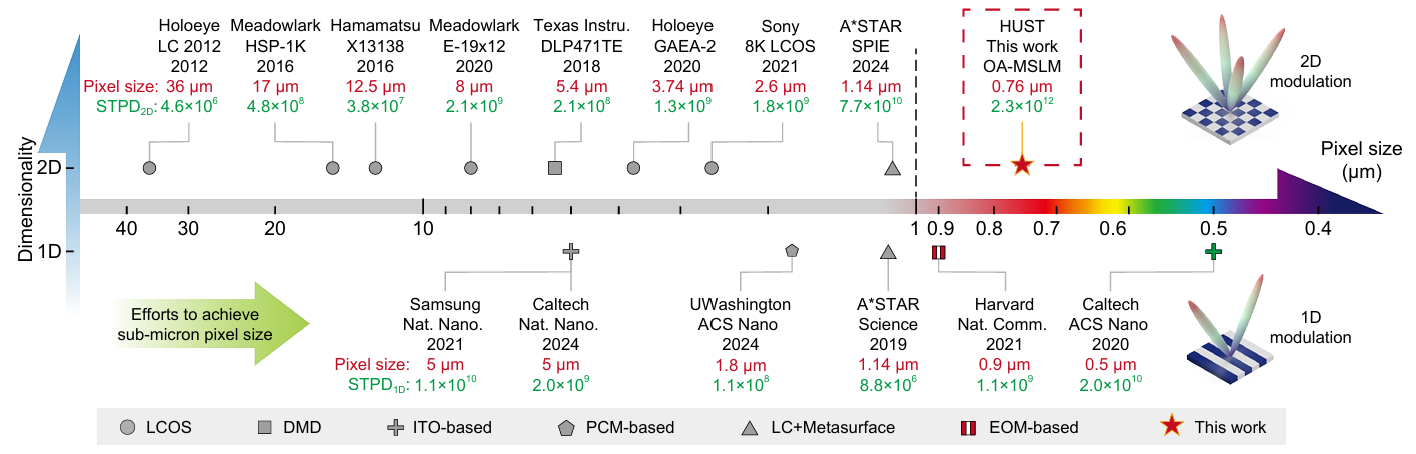
Figure 1 Comparison of pixel size and STPD among various SLMs. Adapted from Extended Data Figure 1 in the original paper.
Meanwhile, nanostructured metasurfaces, which manipulate light via light-matter interactions with periodic arrays of artificially manufactured meta-atoms, show a promising approach for reducing pixel size. Meta-atoms in sub-micrometer scale can be readily fabricated using current semiconductor fabrication technology. However, metasurfaces are mainly passive elements, and therefore they are not suitable for dynamic displays, which need to be reconfigured for every time step.
This article published in Nature Nanotechnology by Fan et. al., makes a breakthrough regarding this limitation by proposing optically addressed metasurface SLM (OA-MSLM). They combine a static metasurface with a dynamic optical addressing technology. Specifically, they group individual prediscretized meta-atoms to form supercells that show a variable response to an incident light according to the combination of meta-atoms in a single supercell being illuminated by the addressing light beam. This approach benefits from both the fast reconfiguration of binary light patterns and the small pixel size of nanostructured metasurfaces, enabling high STPD needed for real-time holographic display technology.
Methods
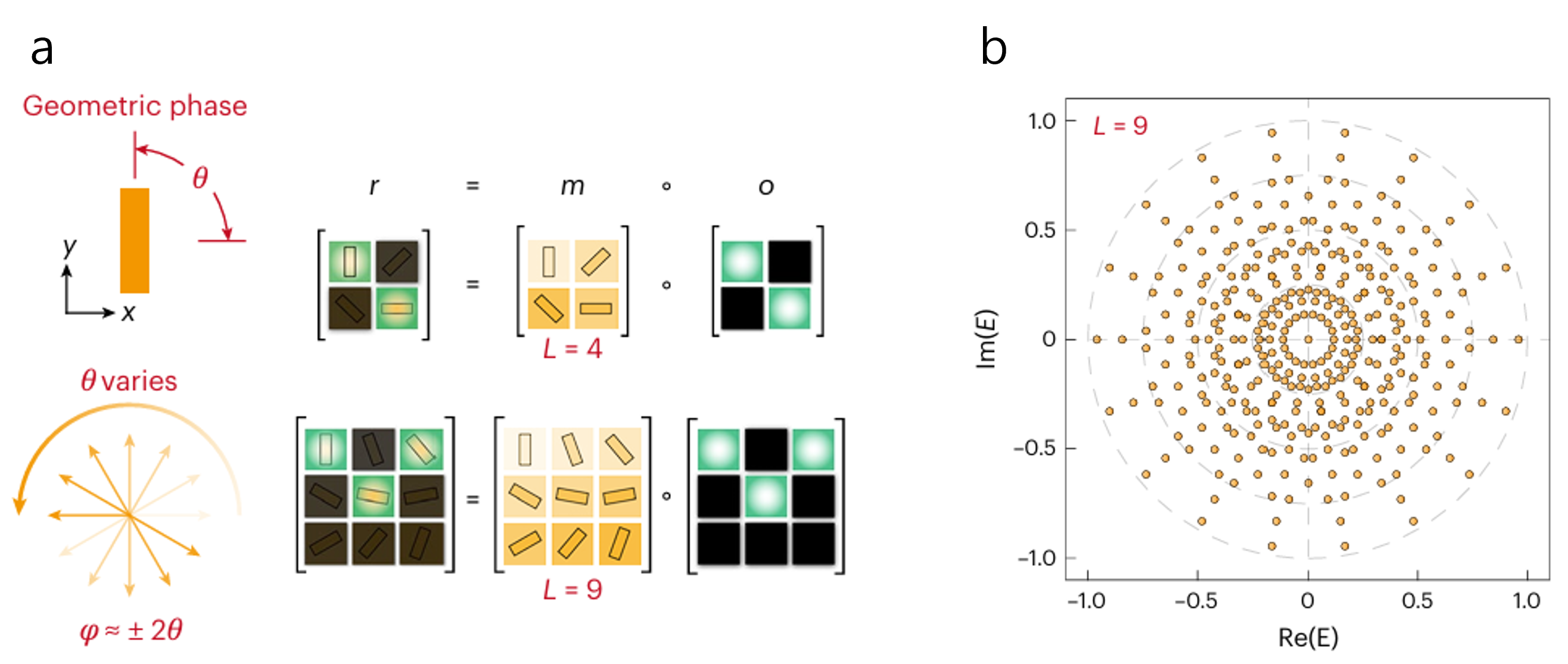
Figure 2 The metasurface supercell utilized in this work. (a) Supercell structure consisting of $L$ individually illuminated meta-atoms. (b) Discretized complex amplitude achievable using the supercell. Adapted from Figure 2 in the original paper.
Figure 2(a) shows the schematic of the meta-atom supercells utilized by the authors. Each supercell consists of $L$ meta-atoms, fabricated from $\rm TiO_2$ on a $\rm SiO_2$ substrate. The meta-atoms included in a single supercell are identical rectangular structures, but rotated in the metasurface plane by discretized angles.
The Jones matrix of a single anisotropic rectangular meta-atom, whose primary axes are rotated by an angle $\theta$ relative to the fixed $x-y$ axes, is expressed as follows:
$$J(\theta) = R(\theta) \begin{bmatrix} t_u & 0 \\ 0 & t_v \end{bmatrix} R(-\theta)$$
Here, $R(\theta)$ denotes the rotation matrix.
The Jones vector of the output light $[E_{x,out}, E_{y,out}]^T$ for a circularly polarized input light $\frac{1}{\sqrt{2}}[1, i\sigma]^T$ is calculated as:
$$\begin{bmatrix}E_{x,out} \\ E_{y,out}\end{bmatrix} = J(\theta) \frac{1}{\sqrt{2}}\begin{bmatrix}1 \\ i\sigma\end{bmatrix} = \frac{1}{2\sqrt{2}} \left((t_u + t_v)\begin{bmatrix}1 \\ i\sigma\end{bmatrix} + (t_u - t_v)e^{2i\sigma \theta}\begin{bmatrix}1 \\ -i\sigma\end{bmatrix}\right)$$
where $\sigma = \pm 1$ corresponds to right circular polarization (RCP) and left circular polarization (LCP), respectively. By tuning the meta-atom structure so that $t_u + t_v = 0$ is satisfied, the authors obtained the meta-atom design that converts incident circularly polarized light to its orthogonal polarization, accompanied by a phase change of $2\theta$. Thus, $L$ meta-atoms rotated by discretized angle $\theta$ from $0$ to $\pi$ in each supercell function as sub-elements which individually introduce $L$ discretized levels of geometric phase change from $0$ to $2\pi$.
Moreover, by selectively illuminating meta-atoms in each supercell, a wider variation in complex amplitude can be obtained. Defining the optical addressing function $O_l$ for $l$-th meta-atom in a supercell as:
$$O_l = \begin{cases} 0, ~~ {\rm not~illuminated} \\ 1, ~~ {\rm illuminated} \end{cases}$$
the collective electromagnetic response of a supercell can be written as:
$$r = \sum_{l=1}^{L} {O_l e^{2i\sigma \theta_l}}$$
where $\theta_l$ is the physical rotation angle of the $l$-th meta-atom. The total possible complex amplitude values using $L=9$ meta-atoms per supercell are plotted by the authors as in Figure 2(b).
The achievable values of complex amplitude are readily discretized by the static structure of the metasurface - each discretized value is selected by appropriate optical addressing. Thus, the authors refer to this platform as a prediscretized metasurface (PDM) platform.
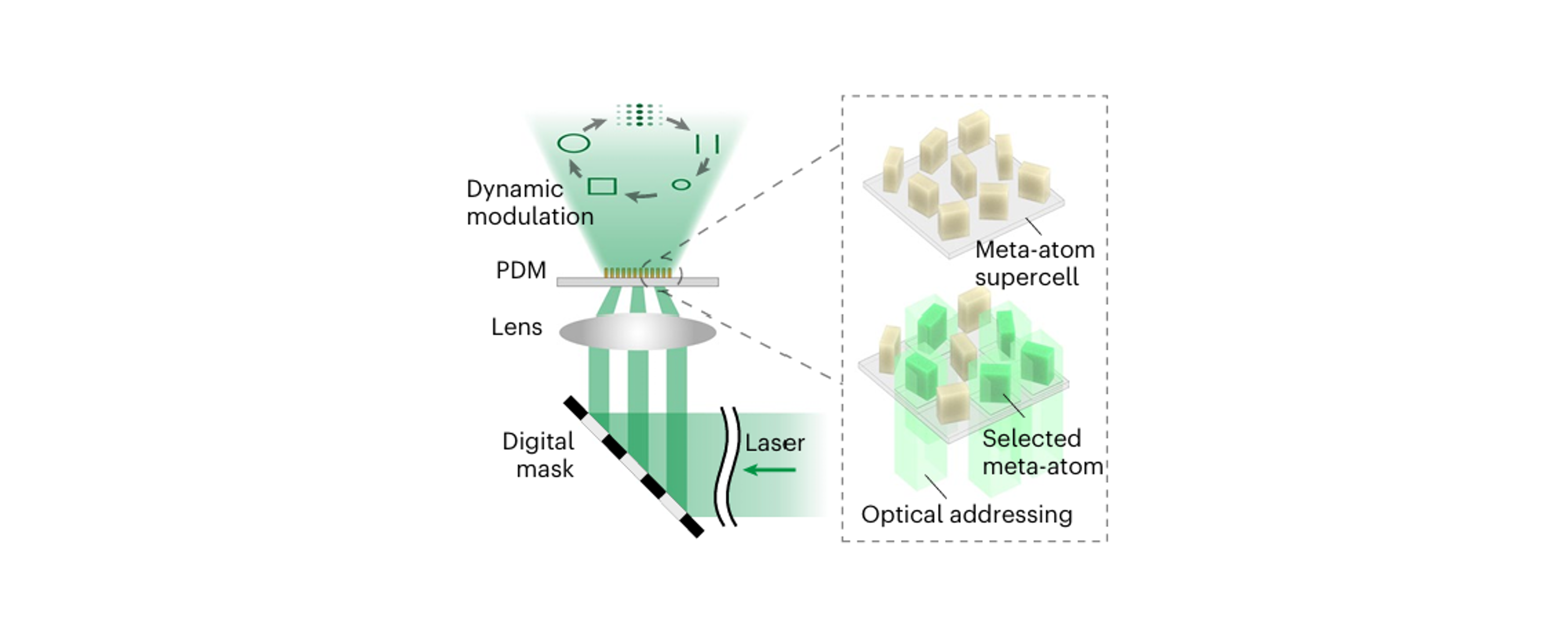
Figure 3 The schematic of the optical addressing setup. Adapted from Figure 3 in the original paper.
Optical addressing is realized using a laser beam with binary amplitude modulation provided by a DMD, followed by a lens system which focuses the modulated beam. The schematic for this setup is illustrated in Figure 3. Each pixel of the DMD functions as a high-speed digital mask, and the focusing lens system reduces the pixel size of DMD-modulated light - origianlly a few micrometers - down to sub-micrometer scale.
Results
The authors successfully built the OA-MSLM system achieving STPD of $2.3 \times 10^{12} {\rm \ pixels \ s^{-1} \ cm^{-2}}$, fulfilling the requirements they suggested for practical real-time holographic display. To showcase the operation of the system, they demonstrated the following five applications:
(1) Static Phase-Only Hologram (POH) and Complex-Amplitude Hologram (CAH)
2D holographic image generation using both POH (via the Gerchberg-Saxton algorithm) and CAH was demonstrated using the same OA-MSLM system. When using CAH, the computation time, the coefficient of variation, the speckle constrast, SSIM, and SNR were all improved compared to POH, suggesting the superiority of complex amplitude modulation enabled by OA-MSLM system over traditional phase-only modulation.
(2) Dynamic Holographic Video Display
A 2D holographic video of pictographic archery scene was demonstrated using the CAH scheme. An ultrashort frame interval of 77 $\rm \mu s$ was achieved, and the display was demonstrated at both far field and near field distances.
(3) Multidimensional Display
Utilizing the two degrees of freedom in CAH, the authors demonstrated control of amplitude profiles at two separate planes. They modified the Gerchberg-Saxton algorithm to enforce a greyscale amplitude distribution of an Albert Einstein image at the SLM plane, while iteratively calculating the phase distribution to obtain an approximate holographic image of the equation $E=mc^2$ at the object plane.
(4) 3D Focusing
The authors demonstrated dynamic 3D focusing by sampling the target 3D image as discrete point sources in the 3D space, and applying Fresnel transform to obtain the required complex amplitude pattern at the SLM. They rendered a temporal series of sampled letter patterns, as well as a 3D spiral helix pattern.
(5) Dynamic Beam Steering
Beem steering, in addition to holographic imaging, was demonstrated. By tuning the optical addressing profile at the metasurface, the authors obtained a maximum deflection angle of $20.6 \degree$, which outperforms existing 2D SLMs. The on/off response times of the optical addressing were measured as 2.8 $\rm \mu s$ and 0.45 $\rm \mu s$, respectively, meeting the requirements for LiDAR applications.
Comments
The idea of separating the addressing and modulation mechanisms - so that metasurface handles modulation with high spatial resolution, while the DMD enables addressing with high temporal resolution - is conceptually simple yet highly powerful. A key strength of this work is the successful demonstration of wide range of applications, including static and dynamic holographic image generation, as well as high-speed beam steering for LiDAR.
Because the proposed OA-MSLM system relies on discretized set of accessible complex amplitudes, varying these discrete values inherently affects the quality of reconstructed images. Utilizing the supercell method, the authors constructed discretization points with equal amplitudes and evenly distributed phases, and binary superpositions of these states. While the wave aberration due to discretization decreases as more phase levels are used, increasing the levels of discretization requires more meta-atoms in a single superpixel. This enlarges the pixel size, and thus deteriorates the STPD. Therefore, investigating more efficient methods for complex amplitude discretization, alongside corresponding design schemes for metasurface structures, would be a promising direction for further research.