Ever since their discovery in the late 19th century, liquid crystals (LCs) have been the subject of extensive research, highlighted by the Nobel Prize awarded to Pierre-Gilles de Gennes in 1991. Nowadays LCs are utilized in a wide range of applications, especially in display technologies; Liquid Crystal Displays (LCDs) dominated the global display market throughout the 2000s and 2010s. This tremendous success of LC applications was largely made possible by their tunability under external electric fields. In this article, the underlying physics of this tunability is covered in detail.
What is a Liquid Crystal?
A liquid crystal is a state of matter that exhibits the properties of both liquids and solid crystals. It flows like a conventional liquid, but its constituent molecules maintain a fairly fixed orientation relative to one another, similar to the structure of a crystalline solid.
A typical LC molecule is rod-shaped. It is uniaxial, meaning it has one long axis while the other two short axes are equivalent. These rod-shaped LC molecules do not point in random directions; their long axes tend to align with each other, though with some fluctuations due to random thermal motion. The preferred orientation of the molecules is represented by a dimensionless unit vector $\bf n$ called the director. This self-alignment behavior can be explained by several models, but we will simply accept it as a given fact for this article.
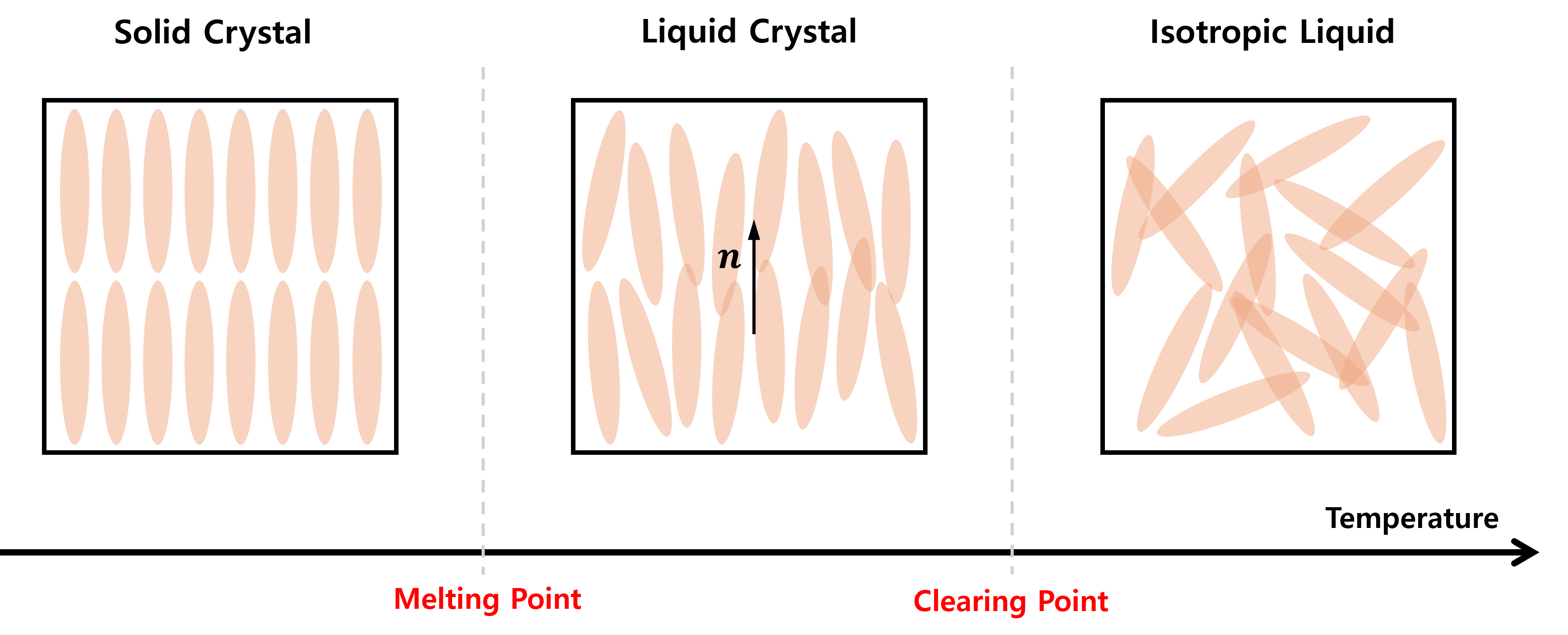
Figure 1 Temperature-dependent phase transitions of a liquid crystal. The unique liquid crystal phase emerges between the solid crystal phase and the isotropic liquid phase. The director $\mathbf{n}$ is depicted for the liquid crystal phase.
Figure 1 describes the phase transitions of a rod-shaped LC as a function of temperature. At low temperatures below the melting point, thermal motion is suppressed. The molecules are stacked and fixed in place, exhibiting a solid crystal phase. At high temperatures above the clearing point, random thermal motion dominates, leading to random orientations of the molecules that form the isotropic liquid phase. The liquid crystal phase appears between the melting point and the clearing point. Here, the individual LC molecules freely flow past one another, yet they maintain a strongly aligned orientation relative to each other.
When an external electric field is applied, the relative alignment of the LC molecules is preserved. However, their collective absolute orientation - represented by the director $\bf n$ - can be altered. Note that an LC does not possess polarity along the director axis: $\bf n$ and $\bf -n$ are equivalent. Therefore, the reorientation of the director is not because of permanent dipole moments simply pulling toward the field. Rather, it arises from dielectric anisotropy of the LC molecules, which results in variations of energy depending on the director's orientation. The director naturally aligns toward the direction of minimum electrostatic energy. Thus, in order to understand this reorientation, we need to calculate the electrostatic energy of this system.
Quick Review: The Electrostatic Energy in Dielectric Systems
Students who have taken an electromagnetics course should be familiar with the following two formulas for evaluating electrostatic energy:
$$W_1 = \int{\frac{1}{2}\epsilon_0 E^2 d^3\mathbf{r}}$$
$$W_2 = \int{\frac{1}{2}\mathbf{D} \cdot \mathbf{E} d^3\mathbf{r}}$$
The question is: what is the "true" energy, and which formula should we use?
To find the answer, recall that these two formulas are derived from the following two equations, respectively:
$$\delta W_1 = \int{(\delta\rho) V d^3 \mathbf{r}}$$
$$\delta W_2 = \int{(\delta\rho_f) V d^3 \mathbf{r}}$$
Here, $V$ denotes the electrostatic potential at the position of the infinitesimal charge increment, $\rho_f$ denotes the free charge density, and $\rho = \rho_f + \rho_b$ is the total charge density ($\rho_b$ being the bound charge density).
$W_1$ is indeed the total electrostatic energy of the system. We bring charges - both free and bound - from infinity and assemble them into the given distribution, and this costs us $W_1$. But usually, this is not the way we form a charge system with dielectric media. Instead, we bring in free charges, and the dielectric medium responds to their introduction by creating bound charges. $W_2$ represents the work required in this process. It includes the work done on the dielectric medium - to stretch and rotate the molecules to form bound charges - rather than bringing them from infinity.
In conclusion, $W_2 = \int{\frac{1}{2}\mathbf{D} \cdot \mathbf{E} d^3\mathbf{r}}$ is the electrostatic energy we are interested in for our dielectric system (the liquid crystals). However, there is one more term that needs to be examined. when we introduce a displacement to the dielectric system, we assume the electric field $\mathbf{E}$ is maintained. To do so, external energy should be supplied by whatever apparatus - perhaps a battery - is creating the electric field. The infinitesimal external work done to introduce an infinitesimal change of free charge density, $\delta \rho_f$, while maintaining a fixed electric field (and consequently, a fixed electrostatic potential) is:
$$\delta W_{ext} = \int{\left(\delta \rho_f\right) V d^3 \mathbf{r}} = \int{\left[\nabla \cdot \left(\delta\mathbf{D}\right)\right] V d^3 \mathbf{r}} = -\int{\delta \mathbf{D} \cdot \nabla V d^3 \mathbf{r}} = \int{\delta \mathbf{D} \cdot \mathbf{E} d^3 \mathbf{r}}$$
Keeping in mind that the electric field $\mathbf{E}$ is held constant during this process, integrating this variation yields the total external work:
$$W_{ext} = \int{\mathbf{D}\cdot\mathbf{E}d^3 \mathbf{r}}$$
Considering the combined system of both the dielectric and the external charge supply, the total energy to be minimized is:
$$W_2 - W_{ext} = -\frac{1}{2} \int {\mathbf{D} \cdot \mathbf{E} d^3 \mathbf{r}}$$
LC Behavior under External Electric Fields
Now we know that the function we need to minimize is $-\frac{1}{2} \int {\mathbf{D} \cdot \mathbf{E} d^3 \mathbf{r}}$. To evaluate this integral, we need to define the relationship between $\mathbf{D}$ and $\mathbf{E}$: $\mathbf{D} = \boldsymbol{\epsilon} \mathbf{E}$. However, in anisotropic media such as liquid crystals, the electric permittivity $\boldsymbol{\epsilon}$ is not a scalar. Instead, it is a tensor:
$$\begin{pmatrix} D_x \\ D_y \\ D_z \end{pmatrix} = \begin{pmatrix} \epsilon_{xx} & \epsilon_{xy} & \epsilon_{xz} \\ \epsilon_{yx} & \epsilon_{yy} & \epsilon_{yz} \\ \epsilon_{zx} & \epsilon_{zy} & \epsilon_{zz} \end{pmatrix}\begin{pmatrix} E_x \\ E_y \\ E_z \end{pmatrix}$$
The $\boldsymbol{\epsilon}$ tensor can be further simplified by utilizing symmetries present in the dielectric system. In our case of liquid crystals, the rod-like shape of the molecules provides rotational symmetry about the director axis. By defining the director axis as "axis 3", and setting "axis 1" and "axis 2" on the plane perpendicular to the director, orthogonal to each other, we obtain the following representation of the $\epsilon$ tensor in the 1-2-3 coordinates:
$$\begin{pmatrix} D_1 \\ D_2 \\ D_3 \end{pmatrix} = \begin{pmatrix} \epsilon_{\perp} & 0 & 0 \\ 0 & \epsilon_{\perp} & 0 \\ 0 & 0 & \epsilon_{\parallel} \end{pmatrix}\begin{pmatrix} E_1 \\ E_2 \\ E_3 \end{pmatrix}$$
Here, $\epsilon_\parallel$ and $\epsilon_\perp$ correspond to the electric permittivity parallel and perpendicular to the director axis, respectively.
Substituting $\mathbf{D}$ with this tensor expression, we get:
$$-\frac{1}{2} \int {\mathbf{D} \cdot \mathbf{E} d^3 \mathbf{r}} = -\frac{1}{2}\int{\left( \epsilon_{\parallel}E_3^2 + \epsilon_{\perp}\left(E_1^2+E_2^2\right) \right)d^3 \mathbf{r}} = -\frac{1}{2}\int{\left( \left(\epsilon_{\parallel}-\epsilon_\perp\right)E_3^2 + \epsilon_{\perp}\left|\mathbf{E}\right|^2 \right)d^3 \mathbf{r}}$$
Since $\left|\mathbf{E}\right|^2 = E_1^2 + E_2 ^2 + E_3^2$ is fixed, this energy value is minimized when $\left(\epsilon_\parallel - \epsilon_\perp\right)E_3^2$ is maximized. There are two distinct cases for this maximum, depending on the sign of $\epsilon_\parallel - \epsilon_\perp$.
Case 1. $\epsilon_\parallel - \epsilon_\perp > 0$
In this case, the minimum energy occurs when $\left|\mathbf{E}\right|^2 = E_3 ^2$, which means that the director $\mathbf{n}$ is aligned parallel to the external electric field $\mathbf{E}$. This type of liquid crystal is called a positive LC. Note that the sign of $E_3$ does not matter since the director $\mathbf{n}$ itself has inversion symmetry, as discussed above.
Case 2. $\epsilon_\parallel - \epsilon_\perp < 0$
Conversely, if the term is negative, the minimum energy occurs when $E_3 = 0$, which means that the director $\mathbf{n}$ is aligned perpendicular to the external electric field $\mathbf{E}$. This type of liquid crystal is called a negative LC.
Therefore, we have successfully deduced that under an applied electric field, the LC molecules orient themselves such that the director - their preferred macroscopic orientation - coincides with the direction of the electric field or the direction perpendicular to it.